> ## Documentation Index
> Fetch the complete documentation index at: https://docs.trunk.io/llms.txt
> Use this file to discover all available pages before exploring further.
# Dynamic CI
> Run only the CI jobs a pull request needs, decided from your own CI history.
Dynamic CI is in **private beta**. Recommendation quality is still improving,
and setup details may change between releases. Reach out on
[Slack](https://slack.trunk.io) to have it enabled for your organization.
Dynamic CI decides which CI jobs a pull request actually needs to run. For each
job, it weighs that job's history, what the pull request changed, and where the
pull request sits in a stack. Anything it can safely skip, it skips, so you
spend less on CI and wait less on each push. Every call comes with a
plain-language reason, and your merge queue backs the whole thing up.
## What it helps with
| If you're having problems with… | Dynamic CI helps by… |
| - | - |
| Paying to run jobs that were never going to fail | Scoring every job against this diff and this pull request's history, and skipping the ones with nothing left to check. Savings are reported per repository, workflow and job. |
| Every push to a PR restarting all your jobs | Only running what hasn't been validated, or what is likely to fail, with special handling for stacked PRs. |
| Path filters and CI rules that get written once and quietly decay | Working out which jobs matter from your own CI history on every push, while still letting you pin any job where you want to be explicit. |
| More concurrent jobs than runners to run them | Taking jobs with nothing to check out of the queue entirely, so your runners go to the work that matters. |
## Backed by the merge queue
A skip on a pull request is only safe if something stronger stands behind it.
With a Trunk [merge queue](/merge-queue/merge-queue), your `main` is protected: the queue
tests the exact commit about to land, and it holds a higher bar than the pull
request.
* **The merge queue skips nothing by default.** On a merge-queue run, Dynamic CI
skips a job only when a paths filter you configured says the change does not
touch it. With no paths filter, every job runs.
* **The engine learns from the queue.** When a job the pull request skipped
fails in the merge queue, Trunk records it as a false skip. The engine learns
from those outcomes, so its skip recommendations get more accurate over time.
A job that rejected a pull request from the queue always runs on that pull
request's next push. See [Merge queues](/ci/dynamic-ci/merge-queue).
## Force a job to run
Sometimes you know something the history does not. The
[Trunk browser extension](/merge-queue/browser-extensions) adds a **Force CI
runs** panel to the GitHub pull request page. Check a job, or a whole workflow,
to force it to run on that pull request regardless of Trunk's recommendation.
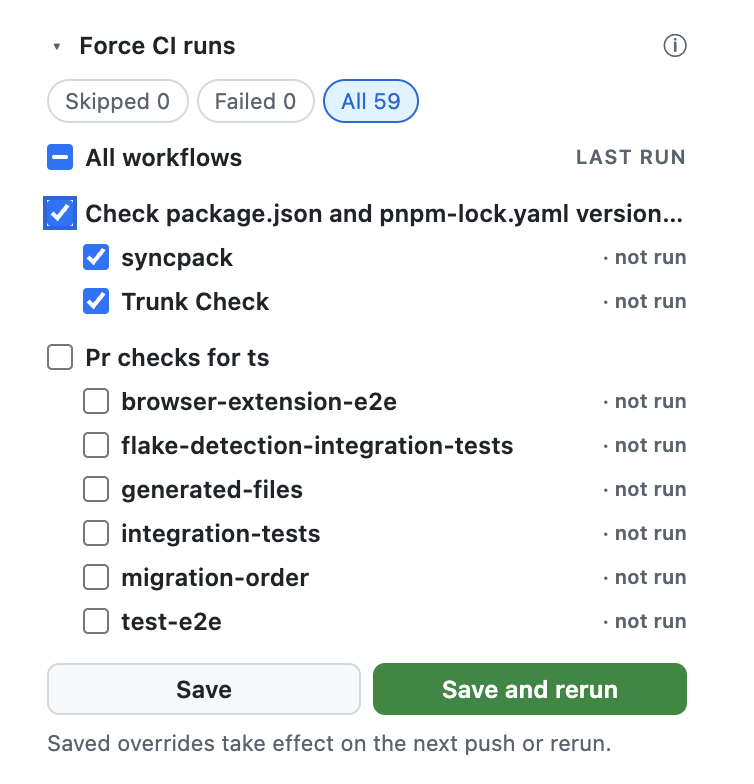
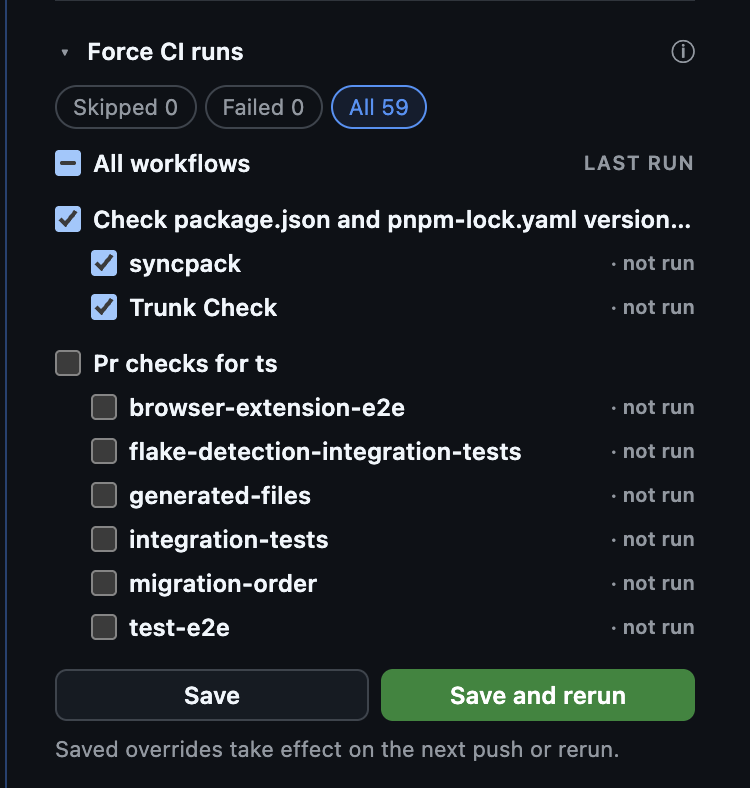 **Save** applies the overrides on the next push or rerun. **Save and rerun**
applies them now: it cancels the pull request's in-progress runs and starts them
again. Overrides are available for GitHub Actions workflows; Buildkite is not supported yet.
## How it decides
For every job, Dynamic CI combines several independent kinds of evidence into
one verdict, **run** or **skip**:
* **The job's own track record**: how often it fails, and how much it costs to run.
* **What the change touches**: how often changes to these files have broken this
job before.
* **This pull request so far**: whether the job has already run on it, and how it
went.
* **Where the pull request sits**: whether other pull requests are stacked on top
of it, and whether the job gates the merge.
* **What the merge queue found**: recent merge-queue failures for this pull
request, and skips the queue later caught.
* **What you told it**: your paths filters, per-job policies and overrides always
take precedence.
Everything it learns comes from your organization's own CI history. Nothing is
pooled across customers.
It is also built to fail safe:
* **A job with no history always runs.**
* **If Trunk is slow or unreachable, everything runs.**
* **Learning mode comes first.** A repository starts in **Learning** mode, where
Trunk records a verdict for every job but skips nothing. Switch it to
**Enforced** once the recommendations look right.
## Get started
Set up Trunk CI, add Dynamic CI to your CI provider, then turn on enforcement.
See [Getting started](/ci/dynamic-ci/getting-started).
## Feedback
Dynamic CI is being tuned against real repositories during the beta, and the
fastest way to change it is to tell us what it got wrong. Reach out on
[Slack](https://slack.trunk.io).
**Save** applies the overrides on the next push or rerun. **Save and rerun**
applies them now: it cancels the pull request's in-progress runs and starts them
again. Overrides are available for GitHub Actions workflows; Buildkite is not supported yet.
## How it decides
For every job, Dynamic CI combines several independent kinds of evidence into
one verdict, **run** or **skip**:
* **The job's own track record**: how often it fails, and how much it costs to run.
* **What the change touches**: how often changes to these files have broken this
job before.
* **This pull request so far**: whether the job has already run on it, and how it
went.
* **Where the pull request sits**: whether other pull requests are stacked on top
of it, and whether the job gates the merge.
* **What the merge queue found**: recent merge-queue failures for this pull
request, and skips the queue later caught.
* **What you told it**: your paths filters, per-job policies and overrides always
take precedence.
Everything it learns comes from your organization's own CI history. Nothing is
pooled across customers.
It is also built to fail safe:
* **A job with no history always runs.**
* **If Trunk is slow or unreachable, everything runs.**
* **Learning mode comes first.** A repository starts in **Learning** mode, where
Trunk records a verdict for every job but skips nothing. Switch it to
**Enforced** once the recommendations look right.
## Get started
Set up Trunk CI, add Dynamic CI to your CI provider, then turn on enforcement.
See [Getting started](/ci/dynamic-ci/getting-started).
## Feedback
Dynamic CI is being tuned against real repositories during the beta, and the
fastest way to change it is to tell us what it got wrong. Reach out on
[Slack](https://slack.trunk.io).